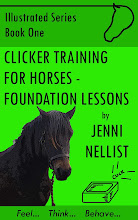
Using the clicker as a training tool is something I've really enjoyed doing for quite a number of years now, and sometimes it's hard for me to understand why anyone wouldn't want to.
http://www.youtube.com/watch?v=1Oy7eBOFaE4
There are differences between using the clicker to train horses and using more traditional or natural horsemanship methods. With the latter we tend to stimulate the horse to perform some behaviour via means of our own actions. We prefer the horse not to do behaviour unless prompted by us. Unwanted behaviour is normally corrected, or more accurately termed, 'punished' by a swift verbal or tactile reprimand.
With the clicker things are different. We, as the trainer, are more passive and instead look for the horse to offer behaviour that we can capture. By 'capture', I mean signal to the horse in the instant that the specific behaviour is being performed that their behaviour has earned them a reward, usually a food titbit. The signal is usually the clicker noise, but it could be another easily perceptible signal, that has previously been associated with the titbit. The horse learns that that click announces food, and any behaviour that the horse can do that makes that happen is normally repeated fairly frequently!
When unwanted behaviour occurs during clicker training it does not normally meet any sort of interuption - unless lives really are at risk! Instead the unwanted behaviour fails to get any sort of reinforcement. Behaviour that fails to earn clicks and treats normally dissappears from the repertoire, but if the worst comes to the worst, incompatible behaviour can be trained to take the place of unwanted behaviour.
My latest example is pawing with the forelimb. This behaviour is normally rooted in frustration at not getting food when the horse expects that it should - after all, horses paw snow covered ground to get the grass beneath, it's a natural instinctive response to frustration. It may also occur when the horse is frustrated in other ways and can't solve the problem in the manner it would like. In this case pawing isn't really appropriate because it won't work to solve the problem. But nevertheless, it is an instinctive, unconscious response to feeling highly frustrated and relatively helpless - but not helpless enough to become shut down and inhibited. In this context, such inappropriate behaviour is referred to as 'displacement' behaviour.
One of my customer's horse's expressed pawing behaviour during training with a more traditional trainer. The behaviour was reprimanded either by a verbal correction, or by jolting the lead rope attached to the horse. The behaviour didn't decrease in frequency until the horse was performing other, incompatible behaviour under direction of the trainer, and therefore was not effectively punished as these reprimands failed to completely inhibit pawing.
This session compared to a more recent session with clicker training was interesting. The session with the traditional trainer had seemed to set a precedent for increased pawing behaviour, something we'd not been seeing recently in our sessions, but it by the most recent session it had made quite the comeback! So, as we were clicker trianing we ignored it - while taking care not to stand in front of the offending forelimbs! Instead we shaped standing still behaviour, in order to set up for new tasks inspired by our traditional trainer. Pawing no longer got any pay off, not even attention - it must be remembered that looking at and speaking to horses when reprimanding them does constitue attention, even if it's not exactly the quality the horse might want. Standing still did get a pay off, and so the horse became confident in performing this behaviour and able to offer further behaviour for us to capture.
So what's the moral of this story? To get into clicker training it may be necesary to let go of ideas about inhibiting behaviour, and to accept that horses can offer behaviour and that we can increase the likliehood of certain offered behaviour by clicking and treating it, and lose behaviour we don't want by ignoring it, and training incompatible behaviour in its place.
Want to know more about clicker training? Why not see my website for a presentation near you?
www.jenninellist.co.uk
Thursday, 3 June 2010


Monday, 1 March 2010
Beware the sharp, pointy, long and yellow teeth!
Aggression is a symtom of fear. Just think about what it takes for you to behave aggressively, such as to feel road rage or snap at a loved one. Aggression involves a lot of emotional energy, normally accompanied by a 'bad hair day'. Behaving aggressively on a regular basis is hard work and emotionally draining. The same is true for our horses and other animals, yet often we counter aggression with more aggression - the horse threatens to bite or kick, and we yell at or hit it! This is fairly natural. We got scared by the horse, and behaved aggressively back. It's true, aggression really is a symptom of fear!
But while I think we can all be forgiven for retaliating in the heat of the moment, we must be careful not to get locked into a downwards spiral of aggressive behaviour. Just think about what you learned last time you were frightened by a horse, and at very least, were tempted to retaliate with further aggression. It's possible that you were scared, and now you are aware of the potential for dangerous, aggressive behaviour from your horse in future. You might have found that this affected your behaviour towards your horse in similar circumstances - maybe you tied your horse up shorter, or were ready to deliver a reprimand in order to prevent being bitten, something we're often taught to do. You are simply more aware of the potential danger, and prepared to defend yourself.
Now think about it from the horse's perspective. The horse bit or kicked because he was scared. Scared of what might be unclear, but it is most probable that he was scared. He then recieved what he considered to be aggresive behaviour in return. This taught him he was right to be afraid, and this has an impact on his future behaviour. If a horse anticipates he may be frightened, then he is already priming himself to use defensive behaviour, including aggression. If he does behave aggressively again, and get the same result, retaliation from a scared human, then future aggression from both parties becomes more likely, unless there is intervention.
It's important to realise just what it is that is setting the horse up for aggression. One way to set horses up for aggression is to put them in situations where there is competition between horses for vital resources such as food, water, dry places to stand, shelter from the elements, and so on. This is one way to ensure a horse experiences mutiple 'bad hair days'. When such resources are in short supply, horses feel more agitated. And when they have repeated aggressive encounters with their herd mates, they feel worse. Feeling uncomfortable like this makes small niggles, such as accidentally jerking the grith when tightening it, into major discomforts that may trigger aggression. Horses may also become more aggressive towards people around their feed bowls, fearing that their people have now taken a liking to horse food and wish to take it from them. Fear of loss is as bad as fear of pain; both are highly averisve to horses.
It is fear of loss that may teach a horse to bite over food. It's a bit of a no-brainer, but hungry horses find being fed a highly pleasurable, and indeed, exciting event. But it's also an unpredictable situation from the horses's perspective. Humans can walk off without notice, taking the food with them, they often do when carrying food past a horse, whether the food is in a bucket or in a pocket. Horses can see this as totally devastating, and they are provoked to solve the 'moving food puzzle'. Horses have little natural preparation for moving food; only when they are a foal does their food actually have legs! Foals resolve the moving food problem by cutting in front of mum, forcing her to 'stand and deliver'. When people walk off with food, horses repeat the same action they used on mum. They catch up, over take, and park themselves in front of us. And if they are very tense, they can take this one step further. When faced with sudden and unexpected removal of something valued so highly, they are triggered to intense fear and frustration, and more extreme aggression is the result.
So what's the solution? Well, it does depend on the horse and the exact situation. But, aggressive horses need to be managed so that they have a happier lifestyle. This way they'll have fewer bad hair days and be less sensitive to aversive situations. But it is also important to remove the source of fear, by identifying it, and then taking action to either avoid it or desensitise and counter condition the horse to it. The aim of desensitisation is to help the horse learn that the perceived threat is nothing to be feared. Counter conditioning teaches the horse to actually enjoy the previously frightening event. In the meantime, it is our responsibility to handle an aggressive horse as calmly as we can possibly muster.
But while I think we can all be forgiven for retaliating in the heat of the moment, we must be careful not to get locked into a downwards spiral of aggressive behaviour. Just think about what you learned last time you were frightened by a horse, and at very least, were tempted to retaliate with further aggression. It's possible that you were scared, and now you are aware of the potential for dangerous, aggressive behaviour from your horse in future. You might have found that this affected your behaviour towards your horse in similar circumstances - maybe you tied your horse up shorter, or were ready to deliver a reprimand in order to prevent being bitten, something we're often taught to do. You are simply more aware of the potential danger, and prepared to defend yourself.
Now think about it from the horse's perspective. The horse bit or kicked because he was scared. Scared of what might be unclear, but it is most probable that he was scared. He then recieved what he considered to be aggresive behaviour in return. This taught him he was right to be afraid, and this has an impact on his future behaviour. If a horse anticipates he may be frightened, then he is already priming himself to use defensive behaviour, including aggression. If he does behave aggressively again, and get the same result, retaliation from a scared human, then future aggression from both parties becomes more likely, unless there is intervention.
It's important to realise just what it is that is setting the horse up for aggression. One way to set horses up for aggression is to put them in situations where there is competition between horses for vital resources such as food, water, dry places to stand, shelter from the elements, and so on. This is one way to ensure a horse experiences mutiple 'bad hair days'. When such resources are in short supply, horses feel more agitated. And when they have repeated aggressive encounters with their herd mates, they feel worse. Feeling uncomfortable like this makes small niggles, such as accidentally jerking the grith when tightening it, into major discomforts that may trigger aggression. Horses may also become more aggressive towards people around their feed bowls, fearing that their people have now taken a liking to horse food and wish to take it from them. Fear of loss is as bad as fear of pain; both are highly averisve to horses.
It is fear of loss that may teach a horse to bite over food. It's a bit of a no-brainer, but hungry horses find being fed a highly pleasurable, and indeed, exciting event. But it's also an unpredictable situation from the horses's perspective. Humans can walk off without notice, taking the food with them, they often do when carrying food past a horse, whether the food is in a bucket or in a pocket. Horses can see this as totally devastating, and they are provoked to solve the 'moving food puzzle'. Horses have little natural preparation for moving food; only when they are a foal does their food actually have legs! Foals resolve the moving food problem by cutting in front of mum, forcing her to 'stand and deliver'. When people walk off with food, horses repeat the same action they used on mum. They catch up, over take, and park themselves in front of us. And if they are very tense, they can take this one step further. When faced with sudden and unexpected removal of something valued so highly, they are triggered to intense fear and frustration, and more extreme aggression is the result.
So what's the solution? Well, it does depend on the horse and the exact situation. But, aggressive horses need to be managed so that they have a happier lifestyle. This way they'll have fewer bad hair days and be less sensitive to aversive situations. But it is also important to remove the source of fear, by identifying it, and then taking action to either avoid it or desensitise and counter condition the horse to it. The aim of desensitisation is to help the horse learn that the perceived threat is nothing to be feared. Counter conditioning teaches the horse to actually enjoy the previously frightening event. In the meantime, it is our responsibility to handle an aggressive horse as calmly as we can possibly muster.
Tuesday, 29 December 2009
Human benefit horse benefit
I love it when both humans and their horses get to benefit from 'behaviour modification'. Fixing a problem so that both the owner and the horse feel rewarded is one of the most positive feelings I can ever get from my work.
One of the requirements for this is empathy towards the owner and horse from my part, and empathy towards the horse from his or her owner. Horses are at our mercy, and to help them our empathy must be as accurate as possible. That includes ditching human-centred values so the process can be pretty tough as simply recognising one is being human and not horse-centred can be hard enough! Knowing this warns me that I must not judge others before I've had a chance to walk in their shoes.
With empathy for horseness in mind, there are pretty much two ways of getting a horse to stop behaving in a way that hinders its human in trying to attain their specific goals with it. Either punish the horse for the 'misbehaviour'. Or alternately teach the horse that another, incompatible behaviour is more rewarding. The specific example I have in mind is in the retraining or behaviour modification of the horse that hates to be clipped.
For that horse, clipping is aversive, why else would the horse try to evade it? Clipping it successfully, i.e. the horse stands still enough for the duration, can be achieved by teaching the horse that moving away results in application of a pressure halter to stop it. This technique seems to be pretty popular according to the magazines. Responses to the pressure halter need to be trained in advance of using the clippers for maximum effect. Essentially the horse learns that it cannot escape the clippers because of the way the pressure halter prevents it from doing so. The horse may then either start to get used to the clippers. This is more likely if they are introduced in incremental stages and do not hurt, and the horse given respite for standing still for short periods. Or the horse may simply become even more fearful of them. This is exacerbated by the fact that the horse cannot use the option of 'flight' to reduce its fear, and this is especially likely if the horse was very scared of clippers rather just than slightly bothered, and if the increments in which the clippers are introduced were too large for that horse. This is the risk whenever response prevention techniques, i.e. trapping the horse, are used.
There is of course an alternative means of helping a horse get over its fear of clippers and increasing the calmer, still behaviour required to get the job done. Teaching the horse to associate the clippers with rewards such as food titbits can make it more likely to see clippers as something positive rather than something that has to be tolerated, or worse - endured because the horse is helpless to do otherwise. A horse might be set up to learn that if he sniffs at the switched off clippers, food treats will suddenly be made available, and then the task can be made gradually more difficult by turning the clippers on. Alternatively the noise of them played quietly in the background could become a signal for a bucket feed. He could also learn that when stroked with the hand, and then with the clippers (turned off of course to begin with) that food is then presented. Standing still to wait for the reward will then come more naturally and willingly. All this can be achieved without having to actually restrain the horse at all.
When the horse learns to stand to be clipped in the first manner, he has no choice, and probably won't perceive any reward in being clipped, just that if he keeps still the clippers will stop eventually. The human may however be quite satisfied. But when the horse is trained via the latter reward-based method, he gets rewarded as well as his human, so now who benefits?
One of the requirements for this is empathy towards the owner and horse from my part, and empathy towards the horse from his or her owner. Horses are at our mercy, and to help them our empathy must be as accurate as possible. That includes ditching human-centred values so the process can be pretty tough as simply recognising one is being human and not horse-centred can be hard enough! Knowing this warns me that I must not judge others before I've had a chance to walk in their shoes.
With empathy for horseness in mind, there are pretty much two ways of getting a horse to stop behaving in a way that hinders its human in trying to attain their specific goals with it. Either punish the horse for the 'misbehaviour'. Or alternately teach the horse that another, incompatible behaviour is more rewarding. The specific example I have in mind is in the retraining or behaviour modification of the horse that hates to be clipped.
For that horse, clipping is aversive, why else would the horse try to evade it? Clipping it successfully, i.e. the horse stands still enough for the duration, can be achieved by teaching the horse that moving away results in application of a pressure halter to stop it. This technique seems to be pretty popular according to the magazines. Responses to the pressure halter need to be trained in advance of using the clippers for maximum effect. Essentially the horse learns that it cannot escape the clippers because of the way the pressure halter prevents it from doing so. The horse may then either start to get used to the clippers. This is more likely if they are introduced in incremental stages and do not hurt, and the horse given respite for standing still for short periods. Or the horse may simply become even more fearful of them. This is exacerbated by the fact that the horse cannot use the option of 'flight' to reduce its fear, and this is especially likely if the horse was very scared of clippers rather just than slightly bothered, and if the increments in which the clippers are introduced were too large for that horse. This is the risk whenever response prevention techniques, i.e. trapping the horse, are used.
There is of course an alternative means of helping a horse get over its fear of clippers and increasing the calmer, still behaviour required to get the job done. Teaching the horse to associate the clippers with rewards such as food titbits can make it more likely to see clippers as something positive rather than something that has to be tolerated, or worse - endured because the horse is helpless to do otherwise. A horse might be set up to learn that if he sniffs at the switched off clippers, food treats will suddenly be made available, and then the task can be made gradually more difficult by turning the clippers on. Alternatively the noise of them played quietly in the background could become a signal for a bucket feed. He could also learn that when stroked with the hand, and then with the clippers (turned off of course to begin with) that food is then presented. Standing still to wait for the reward will then come more naturally and willingly. All this can be achieved without having to actually restrain the horse at all.
When the horse learns to stand to be clipped in the first manner, he has no choice, and probably won't perceive any reward in being clipped, just that if he keeps still the clippers will stop eventually. The human may however be quite satisfied. But when the horse is trained via the latter reward-based method, he gets rewarded as well as his human, so now who benefits?
Monday, 9 November 2009
Patience and Confidence
These are two qualities that most horse people would argue are important in a horse trainer, but where do they come from?
I think they are partly due to the expectations the trainer has of the horse's response to his or her methods.
Knowing my expectations will be met makes me more patient. Keeping that patient attitude when working with a horse makes me more likely to stay calm - but only as long as I have strategically planned my training efforts. As long as I do this I don't become frustrated by lack of progress and get all impatient. When a plan is good my horse is able to meet each goal I create, then I feel successful! Repeated experience of getting it right helps me to be patient more easily, because I know the rewarding sensation of success is just around the corner! I hate that experience of irritation and frustration when a plan doesn't come together! But these experiences prompt me to plan better next time :-)
In my case confidence also comes from the experience of success. If I've succeeded I've also stayed in control! The behaviour change I predicted in the horse actually happened, therefore I stayed in control. The more this happens the more I expect it to happen and the more confident I am of success. This affects how I conduct myself around the horse, and some of that is bound to rub off. Confident, patient people are predicable people who don't look tense or randomly lose the plot. That's got to be reassuring for the horse who also needs that sense of predictability about the world to feel in control.
These two things are the making of great horse trainers, in that sense, great training makes great horse trainers.
I think they are partly due to the expectations the trainer has of the horse's response to his or her methods.
Knowing my expectations will be met makes me more patient. Keeping that patient attitude when working with a horse makes me more likely to stay calm - but only as long as I have strategically planned my training efforts. As long as I do this I don't become frustrated by lack of progress and get all impatient. When a plan is good my horse is able to meet each goal I create, then I feel successful! Repeated experience of getting it right helps me to be patient more easily, because I know the rewarding sensation of success is just around the corner! I hate that experience of irritation and frustration when a plan doesn't come together! But these experiences prompt me to plan better next time :-)
In my case confidence also comes from the experience of success. If I've succeeded I've also stayed in control! The behaviour change I predicted in the horse actually happened, therefore I stayed in control. The more this happens the more I expect it to happen and the more confident I am of success. This affects how I conduct myself around the horse, and some of that is bound to rub off. Confident, patient people are predicable people who don't look tense or randomly lose the plot. That's got to be reassuring for the horse who also needs that sense of predictability about the world to feel in control.
These two things are the making of great horse trainers, in that sense, great training makes great horse trainers.
Wednesday, 17 June 2009
What method?
Horse people are always asking me: what method do I use, what methods do I approve of, what I think of a certain method? Now I have one answer:
I think that there are many roads to Rome and any individual may take the path of their choosing. I think a truly ethical horseperson will make an effort to understand the horse's nature (his ethology if you like), the ways in which horses learn (learning theory derived from the field of psychology), and the means by which horses may suffer, emotionally, mentally and physically.
They will take lessons from the horses they meet, and endeavour to know and understand their horse as an individual. They will then make informed choices as to how to train their horse today. That may differ from how they trained the previous horse yesterday. Tomorrow they may change their approach based on what they learned today.
I personally choose to use positive reinforcement wherever I can. I also teach horses to yield to pressure so that less knowledgeable or ethical horsepersons aren't led to unduly stress them. Sometimes I can only work on the horse's emotional level, sometimes the horse is mentally and physically in a place where I can put higher, competitive goals into the syllabus.
May each of us find our route to Rome, without breaking too many horses on the way
I think that there are many roads to Rome and any individual may take the path of their choosing. I think a truly ethical horseperson will make an effort to understand the horse's nature (his ethology if you like), the ways in which horses learn (learning theory derived from the field of psychology), and the means by which horses may suffer, emotionally, mentally and physically.
They will take lessons from the horses they meet, and endeavour to know and understand their horse as an individual. They will then make informed choices as to how to train their horse today. That may differ from how they trained the previous horse yesterday. Tomorrow they may change their approach based on what they learned today.
I personally choose to use positive reinforcement wherever I can. I also teach horses to yield to pressure so that less knowledgeable or ethical horsepersons aren't led to unduly stress them. Sometimes I can only work on the horse's emotional level, sometimes the horse is mentally and physically in a place where I can put higher, competitive goals into the syllabus.
May each of us find our route to Rome, without breaking too many horses on the way
Friday, 27 February 2009
Who's leading who?
Taking a dog for a walk by its lead and leading a horse more or less require the same things: that the animal in question accepts restraint without fear or frustration; and that they go where their human handler goes.
But why would either dog or horse want to do that? The easiest way to frustrate a dog is put it on a lead and deprive it of its liberty to sniff stuff and interact with other dogs. Horses lose thier liberty too, and often the freedom to flee from fear. And that lead (rope) is not only an infringement of liberty, it's an intrument of pain if it's not used with respect - which all to often it isn't.
Fear, frustration and the potential for pain can be very much reduced if the animal is informed about what to do before the lead is even attached. The animal can learn that sticking close and going where the human goes earns food titbits (or ball games for the dog) that can't be got any other way. If they leave the human's side they get nothing. When the animal gets really good at this the lead can be attached. The potential for large and painful pressures is reduced because the animal already knows what to do. Then it is possible to teach the animal that following, instead of fighting, lead preassures is another way to earn positive reinforcement - as well as the pressure release that would obviously entail.
Dogs and horses can be taught to walk nicely on a loose lead, without fear or frustration, and with no resentment.
But why would either dog or horse want to do that? The easiest way to frustrate a dog is put it on a lead and deprive it of its liberty to sniff stuff and interact with other dogs. Horses lose thier liberty too, and often the freedom to flee from fear. And that lead (rope) is not only an infringement of liberty, it's an intrument of pain if it's not used with respect - which all to often it isn't.
Fear, frustration and the potential for pain can be very much reduced if the animal is informed about what to do before the lead is even attached. The animal can learn that sticking close and going where the human goes earns food titbits (or ball games for the dog) that can't be got any other way. If they leave the human's side they get nothing. When the animal gets really good at this the lead can be attached. The potential for large and painful pressures is reduced because the animal already knows what to do. Then it is possible to teach the animal that following, instead of fighting, lead preassures is another way to earn positive reinforcement - as well as the pressure release that would obviously entail.
Dogs and horses can be taught to walk nicely on a loose lead, without fear or frustration, and with no resentment.
Saturday, 14 February 2009
Training equine emotions
Do horses really enjoy training? Or do we just like to think they do because we enjoy it?
Horses are always having learning experiences, from every single interaction we have with them. Some of those interactions are really pleasurable for the horse, like feeding for example. Some of those interactions may not be so desirable even if they are for the horses own good, like veterinary interventions!
From an ethical and philosophical stand point I think that horses should be able to enjoy training, after all we are simply usuing them for our own gains. It is only fair that if we do that then we should make it possible for horses to volunteer to be used by us rather than be conscripts into our plans!
It's possible to do that. All the interactions we have with our horses are learning opportunities for the horse, and horses are affected by such conditioning at all levels - not just in their behavioural expression. When horses actively seek or are surprised by rewards (the pleasurable stuff they want ot gain, not just the relief from rein or leg pressure we use to motivate them), they get a release of dopamine. This conditions their brain to seek such rewarding experiences again, and aids their expereince and memory of pleasure. Using rewards in training not only changes their behaviour so that they do more of the stuff we rewarded, it also creates a pleasurable association with the learning environment - including us! This means that not only does the horse perform trained behaviours more willingly, he also seeks us out for more rewarding oppportunities. In other words, he starts to become a volunteer.

I see this phenomenon in real life. Every day I see my own horses it is they who approach me, not the other way around. And when I visit others I've helped I see the same thing happening. Horses have started to catch people!
The same thing has been happening in zoos and laboratories where animals are kept and used for various purposes. Animals that have been trainined to approach and cooperate for positive reinforcement actually volunteer for even potentially painful experiences like blood sampling!
If we're going to enjoy using horses then at least let the horses enjoy it too :-)
Subscribe to:
Comments (Atom)